Churn Rate in eCommerce: Formula, Analysis and 8 Ways to Reduce It

- What Is Churn Rate?
- Why Churn Rate Matters for Ecommerce Businesses
- How to Calculate Churn Rate: The Formulas You Need
- What Is a Good Churn Rate for Ecommerce?
- Voluntary vs Involuntary Churn
- Common Causes of Customer Churn in Ecommerce
- How to Do a Churn Rate Analysis
- How to Reduce Churn Rate: 8 Proven Strategies
- How fastrr Checkout Helps You Keep Customers Coming Back
- Conclusion
A shopper buys a face serum from your store in March. They like it, but the parcel arrives four days late, and nobody follows up. By June, they’re buying a similar serum from a marketplace. They never complained. They just didn’t come back.
That silent exit is churn, and your churn rate tells you how often it happens. For an ecommerce brand, it’s one of the clearest signs of whether your growth is built on loyal customers or on ad spend that has to replace leaving buyers every month.
This guide covers the churn rate meaning, the formulas you need, how to read the number for an ecommerce store, how to run a churn rate analysis and the practical ways Indian D2C brands can bring churn down.
What Is Churn Rate?
Churn rate is the percentage of customers who stop doing business with a company during a given period. It’s also called the rate of attrition. Investopedia’s definition of churn rate describes it as the rate at which customers stop doing business with an entity, and that’s the core idea for any business model.
Its mirror image is the retention rate. If you lose 15% of your customers in a quarter, your retention rate is 85%.
Churn Rate Meaning for Ecommerce Stores
For a subscription business, churn is easy to spot. A customer cancels, and they’re gone.
Most ecommerce stores don’t work that way. Nobody “cancels” a relationship with a clothing or skincare brand. They just stop ordering. So, for a non-subscription store, churn has to be defined by inactivity: a customer is churned when they haven’t bought within a window you choose.
A simple rule is to set that window at two to three times your typical repeat-purchase gap. If most repeat buyers of your protein powder reorder within 45 days, a customer with no order in 90 to 135 days is probably churned.
Churn vs Attrition
People often use the two words as one. Some teams separate them. Attrition is natural loss that has nothing to do with you, such as a parent who stops buying baby products once the child grows up. Churn is loss you could have prevented, such as a buyer who left after a bad delivery.
The split matters because you can only fix the second kind.
Why Churn Rate Matters for Ecommerce Businesses
Churn decides how hard your marketing has to work just to stand still. If you lose 30% of your active customers every quarter, your ads must first replace those buyers before they add any growth.
Keeping customers is also cheaper than finding new ones. A Harvard Business Review article on customer retention notes that acquiring a new customer can cost five to 25 times more than retaining an existing one. The same article cites Bain & Company research by Frederick Reichheld, which found that increasing customer retention rates by 5% increases profits by 25% to 95%.
Here’s what lower churn does for an Indian D2C brand:
- Higher customer lifetime value (CLV). Customers who stay longer place more orders, so each one is worth more.
- Better return on ad spend. Rising acquisition costs on Meta and Google hurt less when a bigger share of revenue comes from repeat buyers.
- More prepaid orders. Returning customers who already trust you are more willing to pay upfront, which helps with RTO. Our guide on prepaid orders and how to increase them explains why that matters.
- Earlier warning signs. Rising churn often shows up before a fall in revenue, so it flags product, delivery or service problems early.
How to Calculate Churn Rate: The Formulas You Need
There isn’t just one formula. Each one answers a slightly different question, so pick the ones that match how your store makes money.
1. Customer Churn Rate Formula
This is the standard formula, and the one most people use.
Customer churn rate = (Customers lost during the period ÷ Customers at the start of the period) × 100
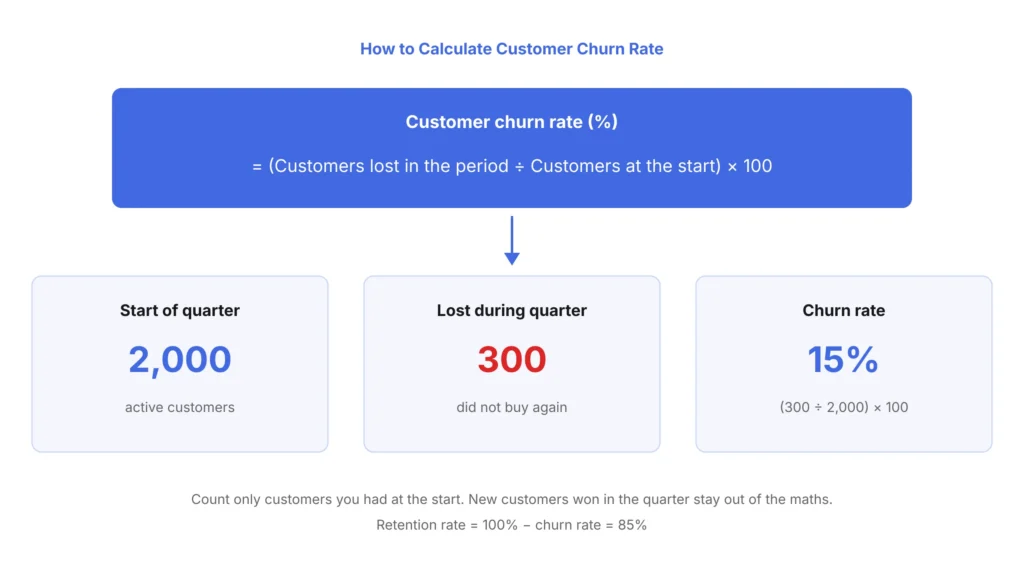
Say you start a quarter with 2,000 active customers. By the end of it, 300 of them haven’t bought again within your churn window. Your customer churn rate is (300 ÷ 2,000) × 100 = 15%, and your retention rate is 85%.
Two rules keep this number honest:
- Leave new customers out. Customers you win during the period aren’t in the starting count, so they shouldn’t change the result. Mixing them in hides real losses.
- Stick to one period. Choose monthly, quarterly or yearly and keep it. Comparing a monthly rate with a quarterly one tells you nothing.
2. Revenue Churn Rate Formula
Customer churn treats every buyer the same. A customer who spent ₹500 once counts the same as one who spent ₹20,000 a year. Revenue churn fixes that.
Revenue churn rate = (Revenue lost from existing customers ÷ Revenue from those customers at the start) × 100
For subscription products, use monthly recurring revenue (MRR). For a regular D2C store, compare the repeat revenue your existing customers generated in one period with the next. If your 2,000 customers brought in ₹10,00,000 last quarter and the ones who churned accounted for ₹1,20,000 of it, your revenue churn is 12%.
If customer churn is high but revenue churn is low, you’re mostly losing small, one-time buyers. If it’s the other way around, your best customers are leaving, and that needs attention fast.
3. Adjusted Churn Rate
Fast-growing stores sometimes look at churn net of new customers:
Adjusted churn rate = ((Customers lost − New customers gained) ÷ Customers at the start) × 100
A negative result means you gained more than you lost. It’s useful as a growth check, but it can hide a leaky bucket, so always look at it alongside plain customer churn.
4. Seasonal Churn Rate
Indian ecommerce is seasonal. Festive sales, wedding season and end-of-season sales bring in waves of one-time buyers who were never likely to stay. Calculating churn separately for peak and regular periods stops a Diwali spike from making the whole year look worse than it is.
Quick Comparison of Churn Formulas
| Metric | What it tells you | Best for |
|---|---|---|
| Customer churn | Share of customers you lost | Every store, as the baseline |
| Revenue churn | Share of repeat revenue you lost | Stores with mixed basket sizes or subscriptions |
| Adjusted churn | Net change after new customers | Quick growth health check |
| Seasonal churn | Churn within peak or slow periods | Brands with big festive or sale spikes |
What Is a Good Churn Rate for Ecommerce?
There’s no single “good” number. It depends on what you sell, how often people need it and whether you sell subscriptions.
Repeat cycles vary a lot by category. A coffee or pet food brand should expect frequent reorders, so high churn is a real warning. A mattress or furniture brand will look like it churns most buyers, simply because people don’t need a new mattress every quarter.
Non-subscription ecommerce does tend to have high churn. Zendesk’s guide on customer churn rate cites Omniconvert data showing ecommerce churn can reach 70–80%. Treat figures like that as context, not a target.
The most useful benchmark is your own history. Track your rate every month or quarter, watch the trend and compare cohorts. Churn that falls from 40% to 32% over a year matters far more than how you rank against an industry average.
Voluntary vs Involuntary Churn
Not every customer who leaves chooses to. Splitting churn into two types tells you where to look for fixes.
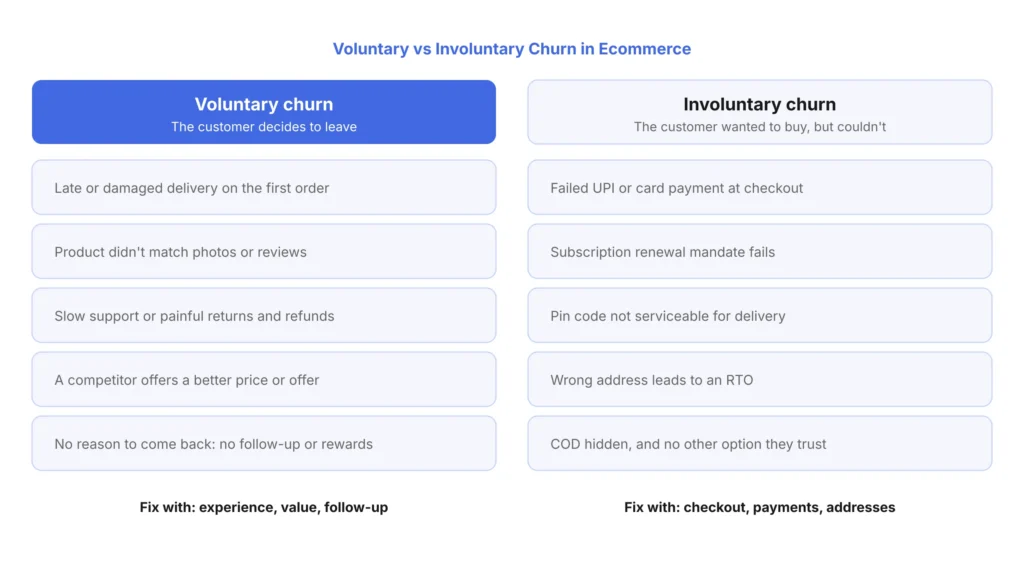
Voluntary churn happens when the customer decides to stop buying. A late first delivery, a product that didn’t match its photos, a messy return or a cheaper rival can all push them away.
Involuntary churn happens when the customer wanted to buy but something blocked them. In Indian ecommerce, the common blockers are failed UPI or card payments, subscription mandates that don’t renew, unserviceable pin codes and wrong addresses that turn an order into an RTO.
Involuntary churn is often the quicker win, because the customer still wants your product. You just need to remove the obstacle.
Common Causes of Customer Churn in Ecommerce
Most churn traces back to a few moments in the customer journey. Mapping that journey, as explained in our guide to customer journey mapping, makes these moments easier to spot.
A Poor First Order
The first order sets the tone. If the parcel arrives late or damaged, or the delivery date keeps slipping, many buyers won’t give you a second chance.
Friction at Checkout
Long forms, repeated OTPs and missing payment options frustrate returning customers as much as new ones. A buyer who has to type their full address again every time has less reason to come back to your store instead of a marketplace.
Failed Payments
A payment that fails twice often ends the session for good. For repeat buyers, it can end the relationship too.
Product and Expectation Gaps
Poor sizing information, filtered photos and vague descriptions lead to returns. Repeated returns or refunds are an early sign a customer is about to leave.
Weak Support and Communication
Slow replies, no order updates and no follow-up after delivery make the brand feel distant. Customers drift away when they hear from you only during sales.
No Reason to Return
Without rewards, reminders or relevant recommendations, even a happy customer can forget your brand. A strong post-purchase experience gives them a reason to come back.
How to Do a Churn Rate Analysis
Knowing the number is step one. Churn rate analysis tells you who is leaving, when and why, so you know what to fix.
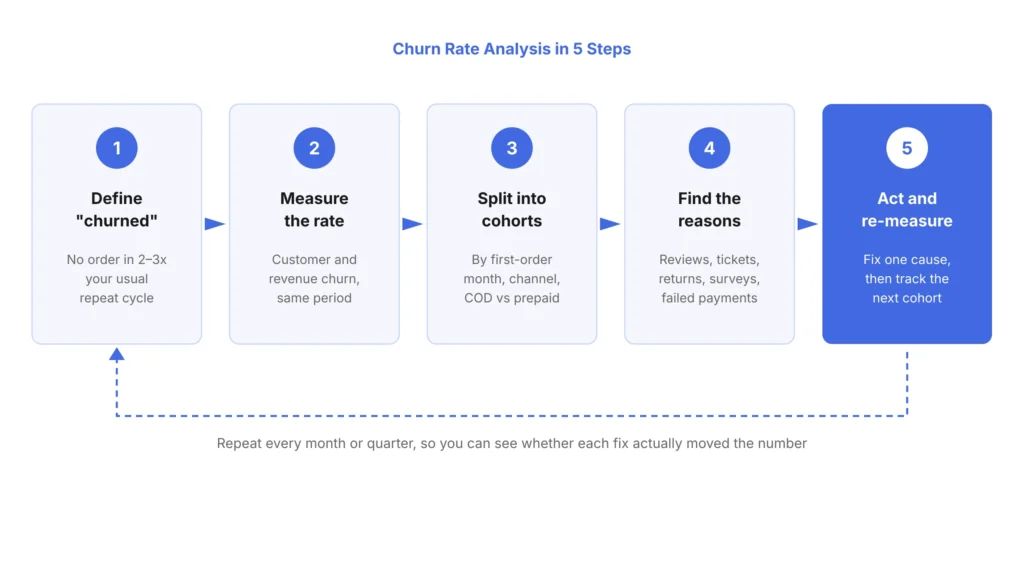
Step 1: Define When a Customer Has Churned
Look at the gap between first and second orders for customers who did come back. Set your churn window at two to three times the typical gap, and keep it fixed so results are comparable.
Step 2: Measure Customer and Revenue Churn
Calculate both rates for the same period. Together, they show whether you’re losing many small buyers or a few valuable ones.
Step 3: Split Customers Into Cohorts
Cohort analysis groups customers by a shared trait and tracks each group over time. Useful cohorts for an Indian D2C store include:
- the month of their first order;
- the acquisition channel, such as Meta ads, Google, influencers or organic search;
- their first payment mode, COD or prepaid;
- the first product or category they bought;
- their city tier or region.
If customers acquired during a heavy-discount sale churn far faster than those from organic search, you’ve learned something about who to target, not just how many left.
Step 4: Find the Reasons
Numbers show the “what”. To find the “why”, read reviews and support tickets, check return reasons and run a short survey for lapsed customers. Also look at checkout data: abandoned checkouts and failed payments from known customers are clear signs of involuntary churn.
Step 5: Act, Then Re-Measure
Pick the cause that affects the most customers or the most revenue, fix it, then track the next cohort to see if churn falls. Change one thing at a time, so you know what worked.
Spot At-Risk Customers Early
Churn analysis also helps you catch customers before they leave. Watch for warning signs such as:
- a longer gap than usual since their last order;
- falling order values;
- more returns, refund requests or complaints;
- no opens or clicks on your emails and WhatsApp messages;
- abandoned carts or failed payments from someone who used to buy without trouble.
How to Reduce Churn Rate: 8 Proven Strategies
Once you know why customers leave, these strategies help them stay.
1. Nail the First Order
Show an accurate delivery date at checkout and meet it. Confirm the order, send tracking updates and check in once it’s delivered. A smooth first experience is the strongest predictor of a second order.
2. Make Repeat Checkout Effortless
Returning buyers shouldn’t have to type their details again. Prefilled addresses, one-tap login and saved payment preferences make buying again faster than going to a competitor. Our guide to increasing checkout conversion rates covers more ways to cut friction.
3. Reduce Failed Payments and Address Errors
Offer the payment methods your customers actually use, including UPI, cards, wallets, BNPL and COD. Validate addresses at checkout, so orders don’t bounce back as RTOs, and give COD buyers a reason to pay upfront next time.
4. Recover Abandoned Carts Quickly
A returning customer who abandons a cart is at risk. A timely WhatsApp, SMS or email reminder with a link back to their saved cart often brings them back. Read our guide to cart abandonment for recovery tactics that work.
5. Reward Loyalty
Points, tiered rewards and post-purchase offers give customers a concrete reason to choose you again. Keep the rewards simple and easy to redeem, or they won’t change behaviour. Ideas from ecommerce gamification can make loyalty programmes more engaging.
6. Personalise Communication
Send reminders timed to each product’s repeat cycle, recommend products that suit what they bought before and segment by cohort. A buyer of a 30-day supplement pack should hear from you around day 25, not during a random sale blast.
7. Fix Support and Returns
Answer questions quickly on the channels customers use, especially WhatsApp. Make returns and refunds clear and quick. A well-handled problem can build more trust than an order that went perfectly.
8. Ask for Feedback and Act on It
Run short surveys after delivery and when customers go quiet. Then close the loop: tell customers what you changed because of their feedback.
How fastrr Checkout Helps You Keep Customers Coming Back
Churn often starts at checkout. fastrr Checkout uses the Shiprocket buyer network to recognise eligible shoppers and prefill their details, and its Skip-OTP flow lets eligible returning prepaid buyers skip the OTP step. Smart QuickPay recommends a shopper’s preferred payment mode based on their past payment pattern on Shiprocket, while Address Correction flags doubtful entries before they become RTOs.
The Advanced RTO Prediction Engine lets you restrict COD only for high-risk shoppers, instead of switching it off for loyal ones.
After the order, fastrr gives customers a reason to return. Integrated Loyalty and Shipcoins reward purchases with points they can redeem later, post-purchase scratch cards offer discounts on the next order, and WhatsApp, SMS and email recovery messages bring back shoppers who leave mid-cart.
Recurring orders and subscriptions handle repeat purchases natively, and Deep Funnel Analytics shows exactly where shoppers drop off. Explore all fastrr Checkout features or see how Shiprocket Checkout can help you turn first-time buyers into repeat customers.
Conclusion
Churn rate is a simple number with a big job. It tells you whether customers stay long enough to make your acquisition costs worthwhile.
Start by defining churn for your store, then calculate both customer and revenue churn on a fixed schedule. Split the results into cohorts, find the real reasons people leave and fix the biggest one first. For most Indian D2C brands, that means a dependable first order, a quick repeat checkout, fewer failed payments and a clear reason to come back.