Payment Routing Guide: How Intelligent Routing Works

- Payment routing decides which gateway, acquirer or rail handles each online payment.
- Static routing sends every payment down one fixed path. Intelligent payment routing picks the best path for each transaction in real time.
- Smart routing lifts payment success rates, cuts processing costs and keeps checkout running when a gateway or bank goes down.
- It runs on live success-rate data, rules engines, machine learning and automatic retries.
- Start with clean data, at least two gateways and clear goals, then test and tune your rules.
- What Is Intelligent Payment Routing?
- What Is Intelligent Payment Routing?
- Why Payment Routing Matters for Payment Performance
- How Intelligent Payment Routing Improves Performance
- How Does Intelligent Payment Routing Work?
- What Technologies Power Intelligent Payment Routing Decisions?
- What Challenges Come With Intelligent Payment Routing?
- How to Design an Intelligent Payment Routing Strategy
- Conclusion
- How fastrr Checkout Keeps Payments Moving
A shopper has filled their cart, picked UPI and tapped “Pay”. The payment fails. They try again, it fails again, and they close the tab. Your product, price and ads all did their job, yet the sale slipped away at the very last step.
Often the problem isn’t the shopper or their bank. It’s the path the payment took. Payment routing is the logic that decides which gateway, acquirer or network a transaction travels through, and when that path is congested or down, good orders fail.
For Indian D2C brands, this matters a lot. Shoppers pay with UPI, cards, net banking, wallets and BNPL, and each method can behave differently across gateways and banks on any given day. This guide explains what payment routing is, how intelligent payment routing works, the technology behind it and how to build a strategy that keeps more payments succeeding.
What Is Intelligent Payment Routing?
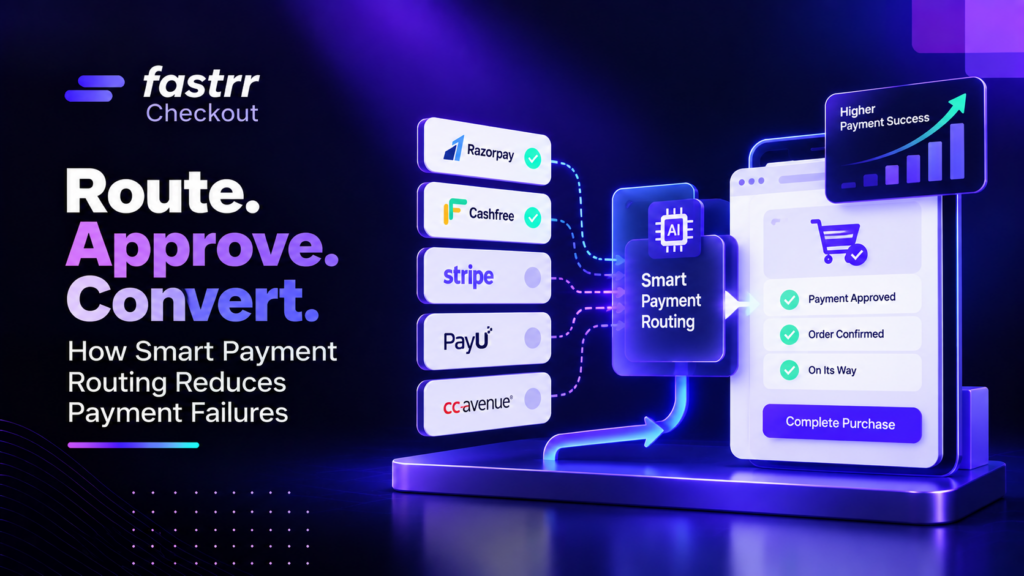
Payment routing is the process of directing an online payment from the checkout to the gateway, processor or acquiring bank that will handle it. Every transaction needs a route, whether you think about it or not.
If your store uses a single payment gateway, your routing is simple: everything goes to that gateway. Once you add a second or third gateway, you need a way to decide which one handles which payment. That decision is routing.
Here’s the basic flow of a payment:
- The shopper picks a payment method and enters their details at checkout.
- The routing layer chooses a gateway or acquirer for the transaction.
- The gateway passes it to the card network, UPI switch or bank for authorisation.
- The issuing bank approves or declines it, and the result comes back to your checkout.
If you want a refresher on who does what in that chain, our explainer on payment gateway vs payment aggregator breaks down the roles.
Static vs Dynamic Routing
There are two broad ways to route payments.
| Static routing | Dynamic (intelligent) routing | |
|---|---|---|
| How routes are set | Fixed rules, set manually | Chosen per transaction, in real time |
| Reacts to outages | Only when someone changes the rules | Automatically shifts traffic |
| Data used | Little or none | Live success rates, cost, latency, card and bank data |
| Best for | Single-gateway or very low-volume stores | Stores with two or more gateways and steady volume |
Static routing is easy to set up, but it’s blind. If your main gateway starts failing UPI payments at 9 pm during a sale, static rules keep sending traffic into the failure until a person notices.
What Is Intelligent Payment Routing?
Intelligent payment routing, also called smart payment routing, chooses the best route for each transaction based on live data. Instead of one fixed path, the system scores every available gateway for that specific payment and sends it where it’s most likely to succeed at the right cost.
The word “best” depends on your goals. For most D2C brands, it means the highest chance of approval. For high-volume stores with thin margins, cost per transaction may also weigh heavily.
Real time payment routing is the core of it. The decision happens in milliseconds, between the shopper tapping “Pay” and the request reaching a gateway, so the shopper never notices it.
Why Payment Routing Matters for Payment Performance
Payment performance is usually measured by payment success rate: the share of attempted payments that complete. Every failed attempt is a shopper who was ready to buy and didn’t.
Routing affects that number in a few direct ways:
- Gateway health changes constantly. A gateway can have a great day for cards and a poor hour for one bank’s net banking.
- Banks behave differently by gateway. The same issuing bank can approve more payments through one acquirer than another.
- Downtime happens. Planned maintenance, bank server issues and traffic spikes during sales can all cause failures.
- Failures cost more than one order. A shopper who hits repeated errors may lose trust in your store and not come back.
India’s payment volumes keep growing, especially on UPI. NPCI’s UPI product statistics track monthly volumes, and the scale means even a small dip in success rate translates into a lot of lost orders for a busy store.
If failed payments are already a concern, our guide to improving your ecommerce payment success rate covers the wider set of fixes that sit alongside routing.
How Intelligent Payment Routing Improves Performance
Smart routing improves results on four fronts.
Higher Payment Success Rates
The biggest win is approval. When the system knows that a particular card-and-bank combination succeeds more often through Gateway B, it sends those payments to Gateway B. Over thousands of transactions, those small choices add up.
Lower Processing Costs
Gateways charge different fees, or MDR, for different methods. When two routes have similar success rates, intelligent routing can pick the cheaper one. You get savings without trading away conversions.
Resilience During Outages
If a gateway or bank starts failing, real-time routing moves traffic away from it within minutes, or even seconds. This matters most during sale events, when traffic peaks and every failure is expensive.
Recovery Through Smart Retries
Some declines are “soft”, caused by timeouts or temporary issues rather than a real problem with the shopper’s account. Smart routing can retry these through a different gateway, a process often called cascading. Hard declines, such as insufficient funds or a blocked card, shouldn’t be retried.
For what to do after a payment has already failed, see our playbook on failed payment recovery.
How Does Intelligent Payment Routing Work?
Under the hood, most smart routing systems follow the same steps.
1. Collect Transaction Data
When the shopper taps “Pay”, the system reads the details it’s allowed to use: payment method, card network, card type, issuing bank, UPI app, amount, device and time of day. It never needs the full card number. In India, the RBI’s card-on-file tokenisation rules mean merchants can’t store actual card data anyway, so routing works with tokens and limited data such as the last four digits and issuer name.
2. Check Live Gateway Health
The router looks at recent performance for each gateway: success rates by method and bank, response times and error codes. Good systems update this every few minutes or continuously.
3. Apply Rules and Score Routes
Your business rules come next. For example, “send all EMI payments to Gateway A” or “never send amounts above a set limit to Gateway C”. Within those rules, the system scores each eligible route on expected success, cost and speed.
4. Send the Payment
The transaction goes to the highest-scoring route. This whole decision takes a fraction of a second.
5. Retry or Fall Back if Needed
If the payment fails with a soft decline or timeout, the system can retry through the next-best route, within the limits the payment method allows. For UPI and cards that need shopper authentication, retries usually mean prompting the shopper again, so the checkout should make that step quick.
6. Learn From the Result
Every success or failure feeds back into the data, so the next routing decision is a little better informed.
The full journey of a payment, from authorisation to settlement, is covered in our guide to transaction lifecycle management.
What Technologies Power Intelligent Payment Routing Decisions?
Several technologies work together behind a smart routing engine.
- Rules engines let your payments team set clear, auditable conditions such as method, amount or bank-based routing.
- Real-time analytics track success rates, latency and error codes per gateway, bank and method as transactions happen.
- Machine learning models spot patterns that fixed rules miss, such as a bank whose approvals drop at certain hours, and predict the best route for each payment.
- APIs and payment orchestration layers connect multiple gateways through one integration, so you don’t have to rebuild your checkout every time you add a provider.
- Tokenisation keeps card data secure and compliant while still letting the router act on what it needs.
- Monitoring and alerting flag sudden drops so your team can act alongside the automation.
Payment orchestration and payment routing are closely linked. Orchestration is the wider layer that manages many providers, and routing is the decision-making part of it.
What Challenges Come With Intelligent Payment Routing?
Smart routing isn’t plug-and-play. Here are the common hurdles.
Integration Effort
Each additional gateway means another contract, onboarding, KYC and integration. Reconciliation also gets harder when settlements arrive from several providers on different cycles. Our guide to ecommerce payment reconciliation explains how to keep that under control.
Data Quality and Volume
Routing models are only as good as their data. A store with low order volumes may not have enough transactions per bank and method to make confident decisions.
Token Portability
Card tokens in India are tied to a specific merchant and token requestor. Saved-card payments may not route freely between gateways unless your setup supports it, so check how each provider handles tokens.
Over-Optimising for Cost
If you route too aggressively towards the cheapest gateway, success rates can slip. Saving a few paise per transaction isn’t worth losing a whole order.
Retry Risks
Retrying hard declines can annoy shoppers, trigger fraud flags at banks and even create duplicate charges if handled badly. Retry logic needs strict limits.
Compliance and Security
Every provider in your stack must meet RBI and PCI-DSS requirements. Adding gateways adds more parties to review. For the basics, see our guide to online payment security.
How to Design an Intelligent Payment Routing Strategy
Here’s a practical, step-by-step approach for a growing D2C brand.
1. Audit Your Current Payment Data
Pull success rates by payment method, bank, card network, UPI app and time of day. Look for patterns, such as one bank’s net banking failing far more often than others.
2. Set Clear Goals
Decide what you’re optimising for. Most brands should put success rate first and cost second. Write down the trade-off you’re willing to make.
3. Add at Least One Backup Gateway
Routing needs options. Pick a second gateway that’s strong where your main one is weak, for example in UPI or a specific card network.
4. Start With Simple Rules
Begin with clear rules: fall back to Gateway B when Gateway A’s UPI success rate drops below a threshold, or route EMI payments to the gateway with the widest bank coverage.
5. Add Real-Time and Data-Driven Routing
Once the rules are stable, move to dynamic routing that uses live success rates. If you have the volume, layer machine learning on top.
6. Define Safe Retry Logic
Retry only soft declines and timeouts, cap the number of retries and make sure the shopper sees a clear message, not a silent loop.
7. Monitor, Test and Tune
Review routing performance weekly. A/B test new rules on a small share of traffic before rolling them out. Watch closely before big sale days.
8. Fix the Checkout Around the Payment
Routing helps only once a shopper reaches the payment step. Address friction, too many form fields and unclear payment options all cause drop-offs before routing even starts.
Conclusion
Payment routing is the quiet layer between “Pay” and “Order confirmed”. Static routing works when you have one gateway and low volume, but it can’t react when a gateway or bank starts failing.
Intelligent routing uses live data, rules, machine learning and smart retries to send each payment where it’s most likely to succeed at a fair cost. Start with your data, add a backup gateway, keep retries safe and keep tuning. Pair it with a low-friction checkout, and more of the shoppers who are ready to pay will actually complete their order.
How fastrr Checkout Keeps Payments Moving
fastrr Checkout is built to protect the payment step for Indian D2C brands. It offers automatic payment mode switching: if a gateway or payment mode starts failing often, the checkout redirects shoppers to a more stable option so they can still complete the order.
Around that, fastrr’s Smart QuickPay recommends a shopper’s preferred payment mode based on their past payment pattern on Shiprocket, and its RTO prediction engine lets you control COD by risk level instead of switching it off for everyone. Finance and payout tracking brings gateway commissions and payout cycles into one view. Explore the full list of fastrr Checkout features or see how fastrr Checkout can help your store convert more of its traffic.