
How a Premium Beauty Retailer Increased Checkout Conversion by 66% with fastrr Checkout

- A premium beauty retailer adopted fastrr Checkout to simplify the final stage of the buying journey.
- Checkout conversion rose from 27.86% in May 2025 to 46.24% in July 2026, representing a 66% improvement.
- Completed monthly orders increased from 95 at onboarding to a high of 681 in March 2026.
- Prepaid orders grew from 27.37% to nearly 70–75% during late 2025 and early 2026.
- The solution included address pre-fill and verification, Estimated Delivery Dates, PIN code-based serviceability checks, multiple payment options, and automated COD risk management to support a more efficient checkout process.
Premium beauty products are often carefully researched before purchase, so by the time shoppers reach the final step of buying, they are usually ready to place an order. For retailers, making that stage simple and reliable can have a direct impact on completed orders.
As online sales grew, one premium beauty retailer wanted to make the purchase process more efficient. In May 2025, it recorded 341 sessions, 95 completed orders, and a conversion rate of 27.86%. While these figures reflected healthy purchase intent, the business saw an opportunity to simplify the buying journey, encourage more prepaid orders, and support increasing order volumes.
To achieve this, the brand implemented fastrr Checkout.
This case study examines how the platform influenced checkout conversion, prepaid adoption, and completed orders over time.
Why Checkout Matters for Premium Beauty Brands?
A quick and straightforward checkout helps reduce unnecessary drop-offs at the final stage of a purchase. For a retailer handling premium beauty products, making this step as simple as possible was important as online orders continued to grow.
The retailer wanted the checkout to support a few key objectives:
- Improve checkout conversion while keeping the buying journey simple.
- Encourage more customers to choose prepaid payments.
- Simplify address entry and verification.
- Display delivery timelines and serviceability before payment.
- Reduce high-risk Cash on Delivery (COD) orders without affecting genuine customers.
These priorities shaped the changes introduced through fastrr Checkout.
How fastrr Checkout Helped Streamline Checkout
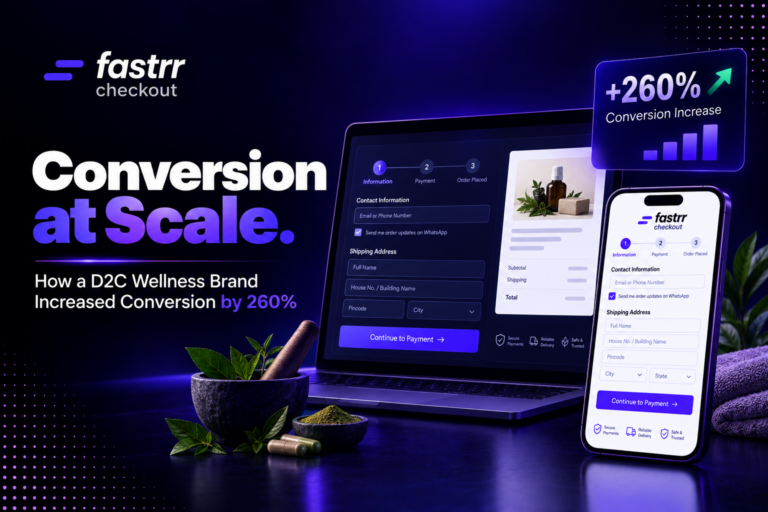
As the premium beauty retailer looked to improve its checkout experience, the focus was on making the final stage of the buying process simpler and more efficient. fastrr Checkout introduced a headless Magento checkout that combined the key checkout functions into a single flow, allowing customers to move from entering their details to completing payment with fewer interruptions.
Address pre-fill and verification minimised the amount of data users needed to enter manually. During checkout, they could also verify the serviceability of their PIN code and view the Estimated Delivery Date (EDD). ‘Fast Delivery’ messages and ‘Limited Time Savings’ prompts were displayed alongside these details.
Customers could choose from multiple payment options through Razorpay and PayU. Bank offers and Quick Pay suggestions were also displayed during payment to encourage prepaid transactions and support higher payment completion rates.
The improvements also supported backend operations. Automated COD risk management restricted Cash on Delivery for high-risk orders, helping reduce potential Return-to-Origin losses without affecting genuine customers. Integrations with GA4, Facebook Pixel (Multi-Pixel), and MoEngage gave the team better visibility into customer journeys and campaign performance, making it easier to monitor checkout performance as the business grew.
What Changed After Implementing fastrr Checkout?
After fastrr Checkout was implemented, the results started to improve over time. Checkout conversion increased, more orders were completed, and prepaid payments accounted for a larger share of total orders:
- Checkout Conversion Increased to 46.24%
The checkout conversion rate increased from 27.86% in May 2025 to 46.24% in July 2026, representing a 66% improvement.
- More Orders Were Completed
Monthly orders grew from 95 at onboarding to a peak of 681 in March 2026.
- Prepaid Payments Increased
Prepaid orders increased from 27.37% at onboarding to nearly 70–75% during late 2025 and early 2026. While the figures varied from month to month, prepaid payments remained well above the starting point.
Conclusion
As order volumes increased, the retailer needed a checkout process that could support growth without adding complexity for customers. Over time, the improvements made through fastrr Checkout reflected in higher checkout conversion, stronger prepaid adoption, and a significant increase in completed orders. The results demonstrate how changes at the checkout stage can influence conversion, prepaid adoption, and completed orders as an eCommerce business grows.