
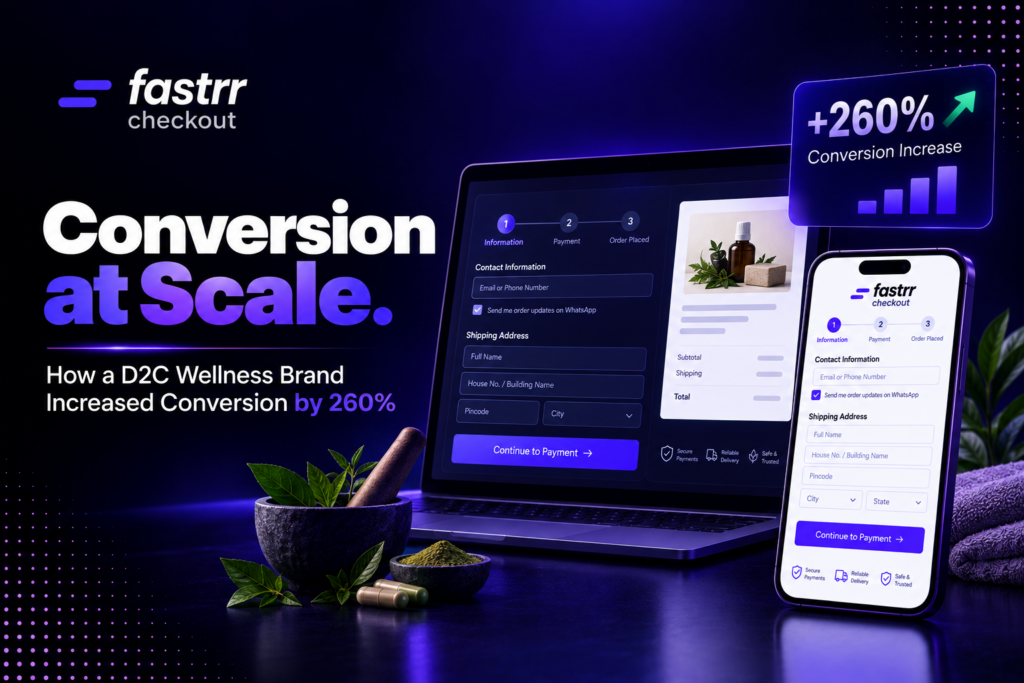
How a D2C Wellness Brand Increased Checkout Conversion by 260% with fastrr Checkout

- A fast-growing D2C wellness brand with 10 lakh+ customers was facing checkout friction from manual OTPs, address entry, failed payments, COD dependency and RTO risk.
- fastrr Checkout helped streamline authentication, address entry, payments, risk management, recovery and trust signals.
- Checkout conversion increased from 6.41% to 23.18%, representing a 260% increase.
- Orders scaled from 5 to 67,297 in the latest 30-day period.
- Prepaid order share increased from 20% to 43.16%, more than doubling.
- fastrr's Order Recovery Screen helped recover 1,396 orders from failed payment journeys.
- Truecaller Login and otpLess achieved peak conversion rates of 52.41% and 51.13%, respectively.
- What Was Holding Back Checkout Conversions?
- How Did fastrr Make Checkout Faster?
- How Did fastrr Increase Prepaid Orders?
- How Did fastrr Help Reduce RTO Risk?
- What Happens When a Customer’s Payment Fails?
- How Did fastrr Build Trust at Checkout?
- What Were the Results?
- What Can D2C Brands Learn From This?
- The fastrr Difference
From 6.41% to 23.18% conversion. From 5 to 67,297 orders. And 1,396 additional orders recovered in just 30 days.
For a fast-growing D2C wellness brand with 10 lakh+ customers, getting shoppers to the checkout wasn’t the problem. Getting them across the finish line was.
Manual OTPs, address entry, failed payments, COD dependency, and RTO risks were creating friction at the most critical stage of the buying journey.
The brand partnered with fastrr Checkout to turn that leaky checkout funnel into a faster, smarter conversion engine.
The result? In the latest 30 days, the brand processed 67,297 orders from 2,90,355 sessions, achieving a 23.18% conversion rate and 43.16% prepaid order share.
What Was Holding Back Checkout Conversions?
A customer can spend minutes browsing a product and make the decision to buy in seconds. That’s why the checkout experience needs to be just as fast.
For this D2C wellness brand, four challenges stood between purchase intent and completed orders:
Too much friction at login
Multiple OTP steps and manual information entry added unnecessary effort, particularly for mobile shoppers.
Failed payments meant lost sales
A failed UPI transaction or payment gateway error could turn a ready-to-buy customer into an abandoned cart.
COD created an RTO problem
With COD playing a significant role in Indian eCommerce, every additional COD order brought the possibility of an RTO and the associated logistics cost.
First-time shoppers needed more confidence
New customers needed a reason to trust the brand and complete their first purchase without hesitation.
The goal was clear: make checkout faster, make payment easier, and make every order safer.
How Did fastrr Make Checkout Faster?
A checkout that remembers the customer
fastrr’s recognition network helped identify returning shoppers and prefill their checkout information, reducing repetitive data entry and enabling a sub-10-second checkout for recognized users.
The authentication layer was further optimized with Truecaller Login, otpLess, and Skip-OTP logic, allowing eligible customers to bypass manual OTP entry.
And the numbers show what happened when friction was removed:
- Truecaller Login: 52.41% peak conversion
- otpLess: 51.13% conversion
For a customer, it meant fewer fields and fewer seconds. For the brand, it meant fewer opportunities for checkout abandonment.
How Did fastrr Increase Prepaid Orders?
Getting customers to choose prepaid over COD isn’t always easy especially in categories where customers are accustomed to paying on delivery.
fastrr tackled this with a simple two-part strategy:
Give customers a reason to pay upfront. Make paying upfront easier.
The brand introduced a 10% discount on prepaid orders, while QuickPay highlighted preferred UPI apps to make payment faster.
The brand also used Express Delivery messaging to turn prepaid into more than just a payment choice and it became a faster way to receive the order.
The result:
Prepaid share increased from 20% to 43.16%.
That’s more than a 2X increase in prepaid adoption.
How Did fastrr Help Reduce RTO Risk?
More orders are great. More bad orders aren’t.
As order volumes scale, COD orders with poor delivery information or a high likelihood of RTO can quickly become expensive.
fastrr’s Address Intelligence helped evaluate delivery information and identify potentially risky orders. For orders flagged with a high RTO probability, the brand could automatically disable COD and steer customers toward prepaid payment.
This created an additional layer of protection without putting unnecessary friction in front of genuine customers.
What Happens When a Customer’s Payment Fails?
Don’t lose the customer just because the payment failed.
That’s the principle behind fastrr’s Order Recovery Screen.
Instead of leaving a shopper at a failed-payment screen, fastrr immediately offered a way forward—retry the payment or switch to another payment method.
In the latest 30 days, this recovery journey helped the brand recover 1,396 orders.
That’s 1,396 purchase attempts that didn’t have to end with “Payment Failed.”
How Did fastrr Build Trust at Checkout?
A first-time customer may have one final question before clicking Pay:
“Can I trust this brand?”
fastrr brought that reassurance directly into the checkout experience through social proof, including the “Loved by 10L+ Customers” message.
The checkout also surfaced Half Price Deals, giving customers another reason to complete their purchase without leaving the buying journey.
Instead of sending shoppers back to product pages to find offers or reassurance, fastrr brought those conversion triggers to the moment of purchase.
What Were the Results?
The transformation becomes clear when comparing the brand’s onboarding period with its latest 30-day performance.
| Metric | Onboarding | Latest 30 Days | Impact |
| Conversion Rate | 6.41% | 23.18% | 2.6 |
| Orders | 5 | 67,297 | Massive scale-up |
| Prepaid Share | 20.00% | 43.16% | 2X+ |
| Order Recovery | 0 | 1,396 | 1,396 orders recovered |
| Sessions | 78 | 2,90,355 | Massive traffic growth |
The biggest change came in checkout conversion.
The brand moved from 6.41% to 23.18%, a 260% increase.
At the same time, sessions scaled from just 78 to 2,90,355, while orders jumped from 5 to 67,297.
And despite that massive increase in scale, the checkout continued converting at 23.18%.
What Can D2C Brands Learn From This?
- Reduce friction before adding more traffic
More traffic doesn’t solve a leaky checkout. Faster authentication, address prefill, and fewer manual steps can help existing traffic convert better.
- Treat failed payments as recoverable revenue
A failed payment isn’t necessarily a lost customer. Giving shoppers an immediate recovery path can turn failed transactions into completed orders.
- Give customers a reason to choose prepaid
The combination of a 10% financial incentive and Express Delivery helped move prepaid adoption from 20% to 43.16%.
- Put trust where the decision happens
Social proof is most valuable when customers are deciding whether to pay. Bringing it directly into checkout can address last-minute hesitation.
The fastrr Difference
fastrr doesn’t treat checkout as a single payment page.
It works across the entire journey:
Recognize → Simplify → Build Trust → Optimize Payment → Manage Risk → Recover
The result is a checkout experience designed to do more than process orders.
For this D2C wellness brand, that meant moving from 6.41% to 23.18% checkout conversion, recovering 1,396 orders in 30 days, increasing prepaid adoption by more than 2X, and scaling to 67,297 orders in a month.
Because when checkout stops getting in the way, growth has room to take over.