B2B Ecommerce: A Complete Guide for Indian Businesses

- What Is B2B Ecommerce?
- B2B vs B2C Ecommerce: Key Differences
- Types of B2B Ecommerce
- B2B Ecommerce Companies and Examples in India
- Benefits of B2B Ecommerce
- Common Challenges in B2B Ecommerce
- Must-Have Features of a B2B Ecommerce Website
- How to Choose a B2B Commerce Platform
- How to Start a B2B Online Store: Step by Step
- B2B Payments and Checkout: What’s Different
- B2B Ecommerce Trends to Watch
- How fastrr Checkout Supports B2B Orders on Your Store
- Conclusion
A kirana owner in Indore used to call three distributors every week, read out an order and wait for a salesperson to confirm the price. Today the same owner can open an app, see their own rates, reorder last week’s list and pay on credit, all before the shop opens.
That shift is B2B ecommerce: businesses buying from other businesses online instead of over the phone, on email or through a field sales rep. Business buyers now expect the same easy, self-serve experience they get as shoppers, and sellers who offer it win the repeat orders.
This guide covers what B2B ecommerce is, how it differs from B2C, the main types and B2B ecommerce companies in India, the features your platform needs and a step-by-step plan to launch your own B2B online store.
What Is B2B Ecommerce?
B2B ecommerce, short for business-to-business ecommerce, is the buying and selling of products or services between businesses through a digital channel. That channel can be your own B2B ecommerce website, a buyer portal, a mobile app or a third-party marketplace.
Think of a packaging maker selling cartons to D2C brands, a pharma distributor supplying chemists, or a textile mill selling fabric to garment units. The buyer is a business, and the purchase feeds its own operations or resale.
The scale is large and growing. Redseer Strategy Consultants estimated in 2022 that India’s B2B ecommerce market could reach $90-100 billion in GMV by 2030, driven mostly by platforms that serve small retailers.
How a B2B Online Order Works
A typical B2B online shopping journey looks like this:
- The buyer logs in to an account set up for their company.
- They see a catalogue with their own negotiated prices and stock levels.
- They add items in bulk, often by SKU or by reordering a past order.
- Larger orders may need a purchase order (PO) or an internal approval.
- They pay upfront, on credit terms or through a mix of both.
- The seller raises a GST invoice, ships the goods and tracks payment.
B2B vs B2C Ecommerce: Key Differences
Both models sell online, but the buyer, the order and the payment are very different. A B2C shopper buys one face serum with UPI in two minutes. A B2B buyer might order 500 units, need sign-off from a manager and pay 30 days later.
| Factor | B2B ecommerce | B2C ecommerce |
|---|---|---|
| Buyer | A business, often several people per account | An individual shopper |
| Order size | Large, bulk quantities | Small, one or a few items |
| Pricing | Custom, tiered or contract prices | Same list price for everyone |
| Buying cycle | Longer, with research and approvals | Short, often an impulse decision |
| Payment | Credit terms, PO, NEFT/RTGS, UPI, cards | UPI, cards, wallets, COD, BNPL |
| Invoicing | GST invoice with buyer GSTIN for input tax credit | Simple tax invoice |
| Relationship | Long-term, repeat orders | Often one-off |
The biggest practical difference is repeat buying. A B2B customer who trusts you will reorder for years, so the experience after the first order matters as much as the first sale.
Types of B2B Ecommerce
Most B2B ecommerce companies fit one or more of these models.
Wholesale Ecommerce
Wholesalers buy in bulk from manufacturers and sell smaller bulk lots to retailers, resellers or institutions. Their online store focuses on minimum order quantities, volume discounts and fast reordering. Resellers often start here, as our guide to building a profitable reseller business explains.
Manufacturer-Direct
Manufacturers sell straight to retailers, distributors or other manufacturers without a middle layer. Going online lets them reach smaller buyers that a field sales team can’t cover profitably.
Distributors
Distributors carry products from many brands and supply a specific region or sector, such as FMCG, auto parts or medical supplies. Their B2B platform needs large catalogues, regional pricing and credit management.
B2B2C
In B2B2C, a business sells to another business that then serves the end consumer. A brand that supplies products to an online retailer, or a D2C brand that also stocks salons and gyms, works in this model.
B2B Marketplaces
A B2B marketplace brings many sellers and business buyers onto one platform. Marketplaces help with discovery, while your own store helps you keep margins and customer data. Our guide to business-to-business marketplace strategies covers how to win on them.
B2B Ecommerce Companies and Examples in India
India’s B2B ecommerce space includes horizontal marketplaces, vertical specialists and brands running their own stores. A few well-known names:
- IndiaMART: an online B2B marketplace where buyers find suppliers and manufacturers across categories.
- Udaan: a trade platform that connects small retailers with brands, wholesalers and traders.
- Amazon Business: Amazon’s B2B store for business buyers, with GST invoices and bulk pricing.
- Moglix: a B2B platform focused on industrial supplies and MRO (maintenance, repair and operations) products.
- TradeIndia: a B2B marketplace and supplier directory for manufacturers and exporters.
Beyond these, thousands of D2C brands now run a separate wholesale page or B2B online store for retailers and corporate buyers. For a deeper look at how leading players work, see these B2B ecommerce examples from India.
Benefits of B2B Ecommerce
Moving B2B sales online pays off for both the seller and the buyer.
- Lower cost per order: Buyers place orders themselves, so your team spends less time on calls, emails and manual order entry.
- Wider reach: A B2B ecommerce website works 24/7 and reaches buyers in tier 2 and tier 3 towns that your sales reps may never visit.
- Fewer errors: Orders arrive with exact SKUs, quantities and addresses instead of handwritten notes or WhatsApp messages.
- Faster reorders: Saved lists and one-tap reordering cut the time a regular buyer needs to place an order.
- Better data: You see what each account buys, how often and at what price, which helps you plan stock and spot upsell chances.
- Freed-up sales teams: Reps stop typing orders and spend their time on new accounts and large deals.
Common Challenges in B2B Ecommerce
B2B ecommerce isn’t simply B2C with bigger carts. Expect these hurdles.
Complex Pricing
Every account may have its own rates, slabs and schemes. Your platform has to show the right price to the right buyer, which is where tiered pricing and customer-specific price lists come in.
Credit and Collections
Many B2B buyers expect to pay on 15, 30 or 60-day terms. Offering credit wins orders, but it ties up your working capital and adds collection risk.
Legacy Systems
Inventory, prices and invoices often live in an ERP or accounting tool such as Tally. If your online store doesn’t sync with it, your team ends up re-entering data by hand.
Change Management
Long-standing buyers are used to calling their rep. You will need incentives, training and patience to move them online.
Must-Have Features of a B2B Ecommerce Website
A strong B2B ecommerce website removes the back-and-forth that slows business buying. These are the features that matter most.
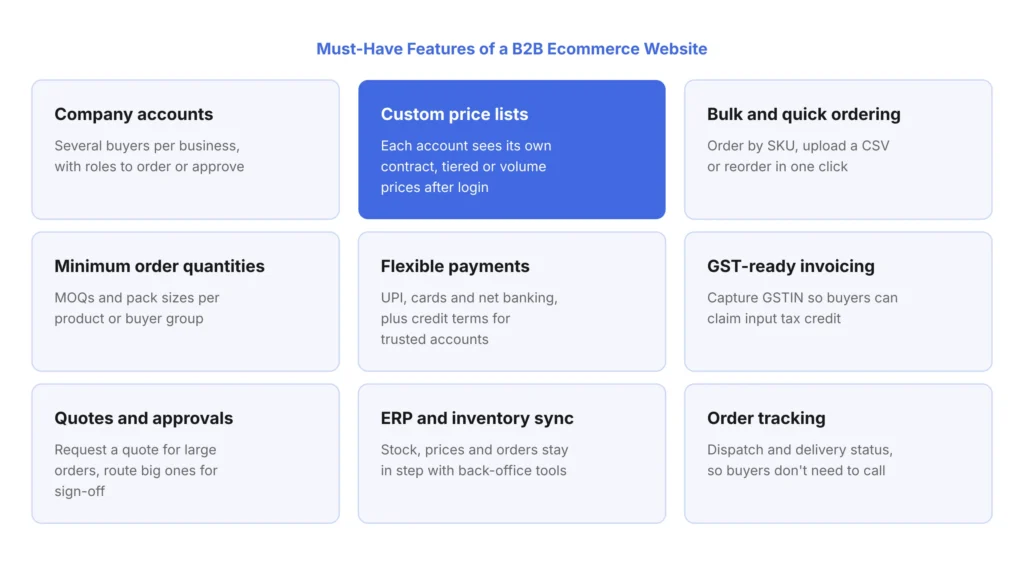
- Company accounts and roles: Several buyers from one business can share an account, with roles for who orders and who approves.
- Custom price lists: Each account sees its own contract, tiered or volume prices after login.
- Bulk and quick ordering: Order by SKU, upload a CSV or reorder a past order in one click.
- Minimum order quantities: Set MOQs and pack sizes per product or per buyer group.
- Flexible payments: Accept prepaid methods such as UPI, cards and net banking, along with credit terms for trusted accounts.
- GST-ready invoicing: Capture the buyer's GSTIN and business name so they can claim input tax credit.
- Quotes and approvals: Let buyers request a quote for large orders and route big purchases for sign-off.
- ERP and inventory sync: Keep stock, prices and orders in step with your back-office tools.
- Order tracking: Show dispatch and delivery status, so buyers don't need to call for updates.
For brands that want a custom front end with these features, headless commerce lets you pair any storefront with a separate commerce engine.
How to Choose a B2B Commerce Platform
B2B commerce platforms fall into a few broad types. Pick the one that matches your size, budget and tech team.
| Platform type | What it is | Best for |
|---|---|---|
| SaaS store builders with B2B features | Hosted platforms such as Shopify or BigCommerce, with wholesale apps or B2B plans | D2C brands adding a B2B channel |
| Open-source platforms | Self-hosted options such as WooCommerce or Magento (Adobe Commerce) | Teams that want full control and have developers |
| Dedicated B2B platforms | Software built for B2B, with quotes, credit and approvals built in | Manufacturers and distributors with complex catalogues |
| Headless setups | A custom front end connected to a commerce engine by APIs | Large brands with unique buying flows |
| Marketplaces | Third-party sites such as IndiaMART or Amazon Business | Discovery and new buyer acquisition |
Before you commit, ask these questions:
- Can it handle per-account pricing and MOQs without custom code?
- Does it connect to your ERP, accounting and shipping tools?
- Does it support the payment methods and credit terms your buyers use?
- Can it scale to your catalogue size and order volume in three years?
- Is the checkout fast on mobile, where many small business owners order?
A solid ecommerce infrastructure matters more than any one feature, because your B2B channel will sit on top of it for years.
How to Start a B2B Online Store: Step by Step
You don't need to move every buyer online on day one. A phased launch works better.
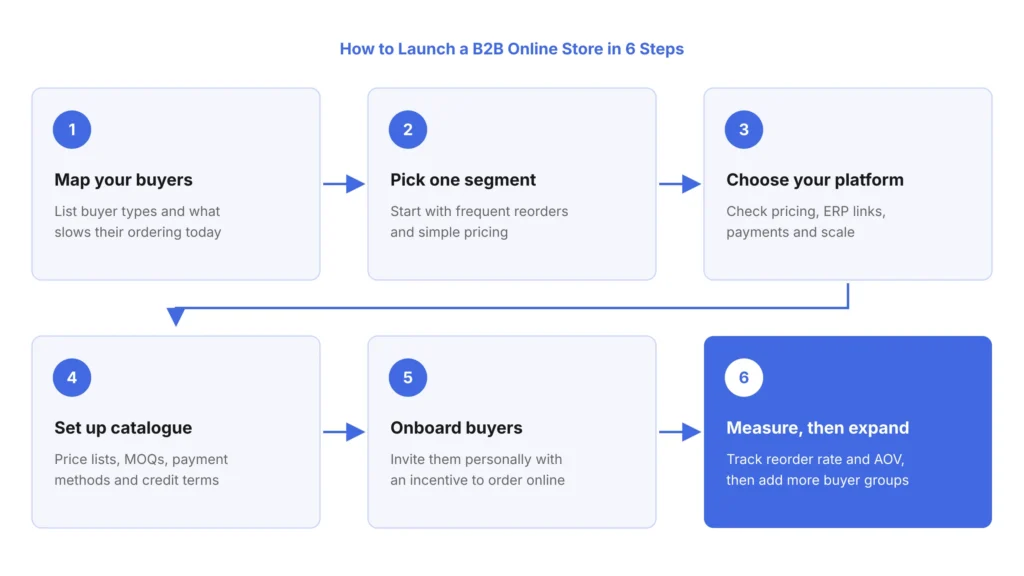
1. Map Your Buyers and Their Pain Points
List your buyer types, such as retailers, distributors and corporate clients. Talk to a few of each and note what slows them down today: price checks, order errors or payment follow-ups.
2. Pick One Segment to Start
Choose the segment with the most repeat orders and the simplest pricing. Small retailers who reorder the same items every week are often the best first group.
3. Choose Your Platform
Use the checklist above. If you already run a D2C store, check whether your current platform can add a B2B channel before you buy something new.
4. Set Up Catalogue, Pricing and Payments
Load products with clear pack sizes, set price lists per account, define MOQs and decide which payment methods and credit terms each buyer group gets.
5. Onboard Buyers With an Incentive
Invite your first buyers personally. A small discount on online orders, faster dispatch or early access to new stock gives them a reason to switch from calling.
6. Measure, Then Expand
Track online order share, average order value, reorder rate, order errors and days sales outstanding. Once the first segment works, add more buyer groups and products.
B2B Payments and Checkout: What’s Different
Payments are where many B2B ecommerce projects stall. Business buyers pay in more ways than consumers, and every payment needs clean records for GST and accounting.
Common B2B Payment Methods
- Bank transfers: NEFT, RTGS and IMPS are standard for large invoices.
- UPI and cards: Popular with small retailers and for smaller, frequent orders.
- Credit terms: Net 15, 30 or 60-day payment for trusted accounts.
- Partial payment: An advance at order with the balance on delivery or on terms.
- Payment links: Sent with a quote or invoice so the buyer can pay in one tap.
If you use more than one payment provider, it helps to know the difference between a payment gateway and a payment aggregator.
GST Invoices and E-Invoicing
Business buyers need a valid GST invoice with their GSTIN to claim input tax credit, so your checkout should capture these details correctly. Since 1 August 2023, businesses with aggregate turnover above ₹5 crore must generate e-invoices for B2B supplies through the government’s Invoice Registration Portal. Check the current rules with your tax adviser.
Reconciliation
B2B sellers receive money through several channels and on different dates. Matching every payment to the right invoice is critical, and our guides to invoice processing and ecommerce payment reconciliation show how to keep it clean.
B2B Ecommerce Trends to Watch
- Self-serve buying: More business buyers prefer to research and order on their own, with a rep only for large or complex deals.
- Mobile-first ordering: Shop owners in smaller towns order from their phones between customers, so mobile speed matters.
- AI-led personalisation: Platforms suggest reorders and related products based on each account’s history.
- Embedded finance: Buy-now-pay-later and credit lines for business buyers are built into checkout.
- Subscriptions and auto-replenishment: Regular consumables ship on a schedule without a fresh order each time.
How fastrr Checkout Supports B2B Orders on Your Store
Many Indian D2C brands sell to retailers, salons, offices and resellers from the same Shopify or WooCommerce store they use for consumers.
fastrr Checkout by Shiprocket helps that store handle business buyers with integrated B2B and GST assistance, which collects and validates the buyer’s GSTIN at checkout. Its custom charge rules engine sets shipping charges by cart weight, city tier and payment mode, which suits heavy bulk orders, and recurring orders and subscriptions support repeat buyers.
Smart Cart’s tiered rewards nudge buyers towards larger orders, the RTO prediction engine lets you restrict COD for high-risk orders, and finance and payout tracking puts gateway commissions and payout cycles in one view. See the full list of fastrr Checkout features or explore fastrr Checkout to make your store ready for business buyers. For palletised or heavy B2B consignments, Shiprocket’s sister product Shiprocket Cargo handles LTL and FTL freight.
Conclusion
B2B ecommerce takes the phone calls, spreadsheets and paper orders out of business buying. Buyers get their own prices, quick reorders and clear invoices, and sellers get lower costs, fewer errors and better data.
Start small. Pick one buyer segment, choose a B2B platform that handles your pricing and payments, and give buyers a reason to order online. Once that first group sticks, expand your B2B online store step by step.