How AI Shopping Assistants Are Rewriting the eCommerce Buying Journey

- What Are AI Shopping Assistants And How Do They Work?
- How Are AI Shopping Assistants Changing the eCommerce Experience?
- 1. Product Discovery Is Becoming More Conversational
- 2. Product Comparison Can Happen Within The Conversation
- 3. Recommendations Can Reflect What The Shopper Says
- 4. Multilingual Shopping Can Become Easier
- 5. Product Pages May No Longer Do All The Explaining
- 6. Routine Customer Queries Can Be Handled Earlier
- 7. Purchase Intent Can Be Captured Earlier
- 8. Accurate Product Data Becomes Even More Important
- 9. The Buying Journey Can Become Less Linear
- 10. AI Assistance and Checkout Need to Connect
- What Benefits Can AI Shopping Assistants Bring to Online Retailers?
- What Challenges Should eCommerce Businesses Consider Before Using Them?
- How Can eCommerce Brands Prepare for AI-Led Shopping?
- How Can fastrr by Shiprocket Turn AI-Led Shopping Into Purchases?
- Conclusion
- FAQs
Online shopping has traditionally relied on search bars, filters, categories, and product pages to help customers find what they need. But that process is starting to change. Instead of working through several listings on their own, shoppers can now ask AI tools questions, compare options, and narrow down products through a conversation.
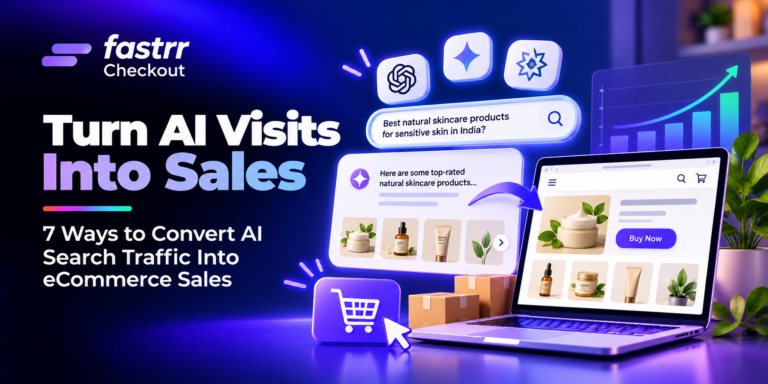
This shift is already reaching the shopping journey. A recent report says that 73% of consumers are using AI during their shopping journey. As shoppers become more comfortable with this way of finding information, eCommerce sellers need to consider how their stores respond when product discovery starts with a question rather than a search term.
That is where AI shopping assistants come in. They can help customers understand products, compare choices, and get relevant recommendations while they are browsing. For sellers, this makes accurate product information, responsive support, and an easy checkout increasingly important.
What Are AI Shopping Assistants And How Do They Work?
An AI shopping assistant is a conversational tool that helps shoppers find products, answer questions, compare options, and move towards a purchase.
A customer might ask, “I need a lightweight moisturiser for oily skin under ₹800.” The assistant can interpret the request and use available catalogue information to suggest relevant options.
In simple terms, it understands the question, checks the information available to it, and responds with an answer or product recommendation. If it is connected to other parts of your store, it can also help the customer continue towards the next step.
The quality of that experience depends heavily on the information behind it. Outdated prices, missing specifications, or incorrect availability can affect the usefulness of the response.
How Are AI Shopping Assistants Changing the eCommerce Experience?
AI is changing how shoppers discover products, compare options, ask questions, and move through the buying journey.
1. Product Discovery Is Becoming More Conversational
Shoppers may not always know the exact product name they need. They may know their budget, intended use, preferred features, or the problem they want to solve.
Instead of relying on exact search terms, they can describe that requirement in ordinary language. This gives your store another way to help customers find relevant products.
2. Product Comparison Can Happen Within The Conversation
A shopper comparing two products may want to know the difference in size, material, features, or suitability without opening several tabs.
An AI assistant can answer those questions using the product information available to it. This makes complete specifications and clear product descriptions increasingly important.
3. Recommendations Can Reflect What The Shopper Says
A shopper might mention a budget, preferred colour, size, or intended use during a conversation. That information can help shape the recommendations they receive.
This can make the interaction feel more relevant than just showing a generic list of popular products.
4. Multilingual Shopping Can Become Easier
Language can make product research harder when shoppers need detailed information before buying.
Multilingual AI conversations can give sellers another way to communicate product information with customers who prefer different languages. fastrr Assist can support real-time multilingual conversations alongside product recommendations and product and order queries.
5. Product Pages May No Longer Do All The Explaining
Product pages still matter, but shoppers may increasingly expect to ask questions instead of reading every detail themselves.
An assistant can explain a specification, clarify a difference, or help narrow down options while the customer is already looking for a product.
6. Routine Customer Queries Can Be Handled Earlier
Questions about products and orders can take up support time, even when the answer is straightforward.
The best AI shopping assistants can handle suitable routine queries within the shopping experience.
7. Purchase Intent Can Be Captured Earlier
There is a clear difference between someone casually browsing a category and someone asking, “Which one should I choose?”
A conversational assistant can respond when a customer is already weighing options. For sellers, that creates a closer connection between product discovery and purchase intent.
8. Accurate Product Data Becomes Even More Important
AI assistants can only work with the information available to them. If your catalogue contains outdated pricing, unclear specifications, missing variants, or incorrect availability, those gaps can affect the answers customers receive.
Keeping product information accurate is therefore becoming a basic requirement for AI-led shopping.
9. The Buying Journey Can Become Less Linear
A customer might ask a question, compare two products, change their requirements, and then return to an earlier option.
That is different from a fixed path of search, category page, product page, cart, and checkout. Your store needs to support shoppers who move between these stages rather than following one predictable sequence.
10. AI Assistance and Checkout Need to Connect
Helping a customer choose a product is only one stage of the journey. They still need to complete the order.
A long form, limited payment options, uncertainty around delivery, or a failed payment can create friction at this point. This is where AI-led shopping increasingly needs to connect with a straightforward checkout experience.
What Benefits Can AI Shopping Assistants Bring to Online Retailers?
For sellers, the value of an AI shopping assistant is not limited to product recommendations. Depending on how it is implemented, it can support several parts of the customer journey.
- Faster discovery: Customers can describe what they need instead of relying only on categories and filters.
- Lower routine support workload: Common product and order questions can be handled within the store.
- More relevant recommendations: Suggestions can reflect details shared during the conversation.
- Multilingual support: Customers can access product information in the language supported by the assistant.
- Closer connection to purchase intent: Questions can be answered while customers are deciding what to buy.
The actual results will depend on factors such as your catalogue, customer behaviour, product range, and how well the assistant is integrated with your store.
What Challenges Should eCommerce Businesses Consider Before Using Them?
AI shopping assistants can make shopping easier, but they also create new areas for sellers to manage.
- Data quality: Product information needs to remain accurate as prices, stock, variants, and specifications change.
- Accuracy: An assistant should not be treated as a replacement for checking important product or order information.
- Human support still has a role: Complex, account-specific, complaint-related, or unusual issues may need a person to step in.
- The experience also needs balance: Not every customer wants to chat with an assistant, so it should add value without getting in the way of normal browsing.
How Can eCommerce Brands Prepare for AI-Led Shopping?
You do not need to rebuild your entire store around AI. Start with the information and processes an assistant will rely on.
- Keep product titles, descriptions, specifications, prices, variants, and availability updated.
- Write product descriptions that answer the questions customers commonly ask.
- Keep catalogue information consistent across products and variants.
- Identify repetitive pre-purchase questions that an assistant could handle.
- Make the path from product recommendation to checkout straightforward.
- Review where customers drop off after receiving product information.
- Keep a clear route to human support for issues that need individual attention.
The aim is to make it easier to move from question to product to purchase.
How Can fastrr by Shiprocket Turn AI-Led Shopping Into Purchases?
fastrr by Shiprocket helps businesses connect AI-powered product discovery with a smoother path to purchase through fastrr Assist and fastrr Checkout.
fastrr Assist is an AI shopping assistant that engages every store visitor 24/7 in multiple languages. It answers product questions, recommends relevant products and guides shoppers towards checkout. It also turns conversations into demand signals, revealing what shoppers want, what they cannot find and where potential revenue is being lost.
fastrr Checkout supports the next step with address pre-fill, multiple payment options, estimated delivery dates, and configurable COD and discount rules to help reduce checkout friction.
Ready to turn more shopping conversations into conversions? Explore fastrr by Shiprocket to discover how AI-powered assistance and a smoother checkout can help your business turn shopper intent into completed purchases.
Conclusion
AI shopping assistants are changing what customers can expect from an online store. Instead of relying entirely on search bars, filters, and product pages, shoppers can increasingly ask questions, compare options, and get guidance as they make a decision.
For sellers, preparing for this shift starts with the basics. Keep product information accurate, make common questions easy to answer, and ensure the checkout does not create unnecessary friction after purchase intent has formed.
The next phase of eCommerce is about connecting product information, assistance, and checkout so that the journey from a customer’s question to an order makes sense. fastrr By Shiprocket bring these capabilities together across the buying journey.