
Cash on Delivery Disadvantages: Challenges & How to Manage COD With fastrr

- Cash on Delivery can help you serve customers who prefer paying when their order arrives, but it can also create RTO, cash-flow, and order-management challenges.
- You can manage COD risk by applying different rules to orders based on factors such as invoice value, destination pincode, lane, risk profile, phone number, or product.
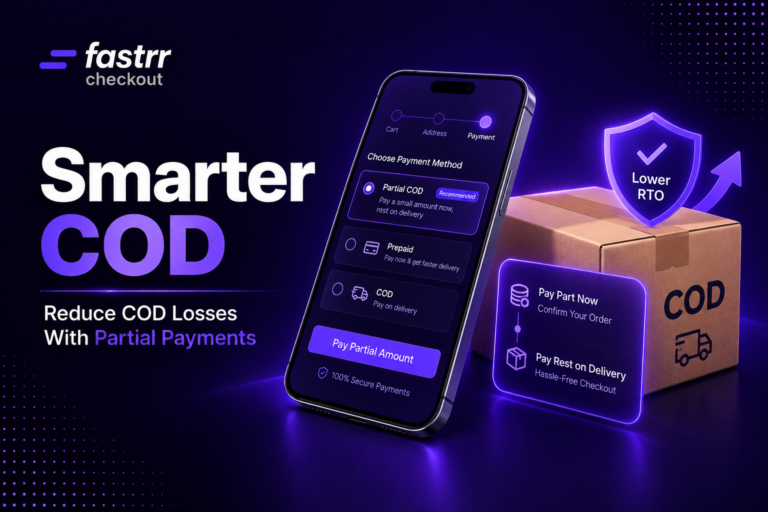
- Partial COD lets you collect a specified percentage upfront while keeping the remaining amount payable through COD.
- Prepaid discounts, COD charges, and COD-to-prepaid conversion can give customers more payment choices while helping you manage COD costs.
- fastrr Checkout lets you create custom COD and payment rules instead of applying the same checkout setting to every order.
- What Are the Biggest Disadvantages of Cash-on-Delivery for Online Sellers?
- How Can Sellers Manage COD Risks and Reduce Failed Deliveries?
- What Practical Steps Can Improve the Cash-on-Delivery Experience?
- How Can fastrr by Shiprocket Help Businesses Manage COD Challenges?
- How Can fastrr Checkout Make the Checkout Experience Smoother?
- Conclusion
If you accept COD orders, you know that the transaction does not end when a customer clicks “Place Order”. The parcel still needs to reach the customer, the payment needs to be collected, and the order needs to avoid a failed delivery. A customer may change their mind, provide an incomplete address, or not be available when the parcel arrives.
Around 60% of all eCommerce orders in India are still placed through cash on delivery (COD). At the same time, around 25% to 30% of COD orders can end up as return to origin (RTO), adding to the cost and effort involved in fulfilling these orders.
This is why how to handle the disadvantages of cash on delivery with fastrr by Shiprocket is an important consideration for online sellers. Instead of treating every COD order in the same way, you can apply different payment and checkout rules based on the order, customer, destination, or risk profile.
What Are the Biggest Disadvantages of Cash-on-Delivery for Online Sellers?
COD gives customers the option to pay at delivery, but that payment method can create certain challenges for sellers.
Return to Origin (RTO)
A COD order can become an RTO when the delivery is unsuccessful, or the customer refuses to accept the parcel. You may then have to deal with forward and return shipping costs without completing the sale.
Delayed Payment
With prepaid orders, payment is collected before dispatch. COD payment is collected at delivery, so the timing of the payment reaching your business is different. This can affect how you manage working capital, particularly when your order volume is growing.
Low-Intent Orders
Some customers may place an order without being fully committed to completing the purchase. If they later change their mind or do not accept the delivery, the order can add to your RTO costs.
Incorrect Delivery Details
An incomplete or incorrect address can make it difficult for the delivery partner to reach the customer. If the mistake is noticed only after the order has been dispatched, correcting the address can take time and may affect the delivery attempt.
Additional COD Costs
COD can also involve additional handling charges. When you process a large number of COD orders, these costs can become an important part of your checkout economics.
How Can Sellers Manage COD Risks and Reduce Failed Deliveries?
You do not have to apply one COD rule to every order. A more flexible approach is to decide where COD should be available and what conditions should apply to different orders.
Use Order-Based Rules
You can create rules based on factors such as:
- Invoice value: Apply different COD conditions to different order values.
- Destination pincode: Set rules for selected delivery locations.
- Lane: Apply different conditions based on the origin-to-destination route.
- Risk profile: Use risk information to apply tighter controls to higher-risk orders.
- Phone number: Create rules for selected phone numbers.
- Product stock keeping unit (SKU): Apply different payment conditions to specific products.
Use Partial COD Where It Fits
Partial COD can be useful when you want to retain COD while collecting part of the order value upfront. You can set the applicable percentage through your checkout rules, with the remaining amount collected through COD.
This gives you another payment arrangement for orders where full COD may carry more risk.
What Practical Steps Can Improve the Cash-on-Delivery Experience?
Managing COD does not only mean restricting it. You can also make prepaid payment more appealing and give customers more flexibility.
- Offer a prepaid discount: A fixed or percentage-based discount can give customers more reason to choose a digital payment method.
- Apply a COD charge: You can configure a fixed or percentage-based COD charge to account for the additional cost associated with COD orders.
- Enable COD-to-prepaid conversion: Give customers a defined time window to change an existing COD order to prepaid, with an applicable discount.
- Use partial COD: Collect a specified portion upfront while keeping the remaining amount payable at delivery.
- Keep payment choices clear: Showing available payment options clearly at checkout makes it easier for customers to choose how they want to pay.
These controls let you manage payment preferences without treating COD as an all-or-nothing option.
How Can fastrr by Shiprocket Help Businesses Manage COD Challenges?
fastrr by Shiprocket gives you checkout controls that can be configured around the way your business handles COD.
Risk-Based COD Controls
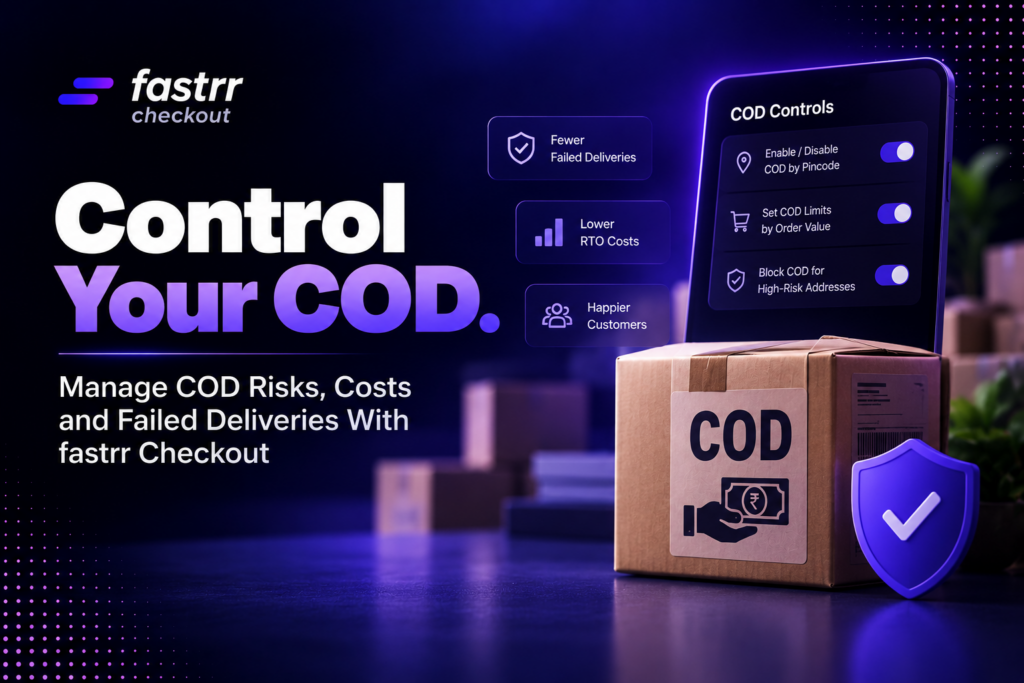
fastrr supports custom Disable COD rules. You can define criteria such as invoice value, destination pincode, lane, risk profile, phone number, product SKU, or product collection, and use those conditions to determine when COD should be unavailable.
This means you can apply tighter payment rules to selected orders rather than disabling COD across your entire store.
Partial COD
fastrr lets you configure Partial COD for selected criteria. You can specify the percentage to be collected upfront and decide whether shipping charges are included in that calculation.
COD Charges
You can configure fixed or percentage-based COD charges. These charges can also be applied according to the criteria you set, giving you more control over how COD is presented to different orders.
COD-to-Prepaid Conversion
fastrr supports COD-to-prepaid discounts, allowing customers to switch from COD to prepaid within a configured time window. You can set a fixed or percentage-based discount for this conversion.
Prepaid Discounts
You can also create payment-specific discounts to encourage customers to choose prepaid payment at checkout. These can be configured as fixed or percentage-based discounts.
How Can fastrr Checkout Make the Checkout Experience Smoother?
COD management begins at checkout, so the payment experience itself matters. fastrr Checkout brings several checkout features together to reduce unnecessary friction while giving sellers more control.
Faster Address Entry
Address autofill can reduce the amount of information a returning shopper needs to enter manually. This can make checkout easier while helping sellers capture delivery information earlier in the order journey.
Multiple Payment Options
Giving customers access to different payment methods means you can offer prepaid options alongside COD rather than relying on one payment method for every order.
Payment-Mode Discounts
Payment-specific discounts can be used to make prepaid payment more attractive. Instead of removing COD completely, you can give customers a financial reason to select another payment method.
Estimated Delivery Information
Showing an estimated delivery date at checkout gives customers more information before they place the order. Clear delivery expectations can make the payment decision easier and help customers understand when they can expect the parcel.
Risk Management at Checkout
fastrr also brings COD and RTO controls closer to the point where customers select their payment method. You can use configured rules to determine when COD should be available and when another payment arrangement may apply.
For sellers, this means COD management becomes part of the checkout process rather than a separate task after the order has already been placed.
Conclusion
COD can be useful for reaching customers who prefer paying at delivery, but it does not have to work the same way for every order. You can decide where COD fits, which orders need additional controls, and when prepaid payment should be encouraged.
With fastrr by Shiprocket, you can put those choices into checkout rules through disable COD, partial COD, COD charges, prepaid discounts, and COD-to-prepaid conversion. You can also use criteria such as invoice value, pincode, lane, risk profile, phone number, or product to create more specific conditions. This gives you a way to manage COD as a configurable part of your checkout rather than a fixed payment setting for every customer.