

What Are Smart Shopping Carts? Features, Benefits and Best Options for 2026

- What Are Smart Shopping Carts?
- Why Traditional Online Shopping Carts No Longer Work
- Where Do Smart Shopping Carts Work Best?
- What Are the Operational Benefits for Retailers?
- What Are the Challenges of Adopting Smart Shopping Carts?
- Which Are the 7 Best Smart Shopping Carts in 2026?
- How Shiprocket Checkout Enhances AI-Driven Retail Experiences
- Conclusion
Online shoppers often abandon carts because of unclear pricing, extra steps at checkout, hidden charges, or too much effort to complete a purchase. This can mean losing valuable orders even when customers are ready to buy. In fact, a 2024 study shows that nearly 70% of online carts are abandoned before purchase, highlighting the revenue at stake.
A smart shopping cart can help. By using real-time data and automation, it removes obstacles at checkout, making it easier for customers to complete their orders. For sellers in smaller markets, this means capturing more sales, reducing cart abandonment, and competing confidently with larger online stores.
What Are Smart Shopping Carts?
A smart shopping cart is a digital cart that does more than just hold selected products. It uses automation and customer behaviour insights to guide shoppers smoothly from selection to payment.
Smart shopping carts can update prices, taxes, discounts, and other charges instantly. They track shopper behaviour and reduce unnecessary steps before checkout, helping customers clearly see what they are paying for. These features lower the risk of cart abandonment and improve the chances of completing a sale.
Why Traditional Online Shopping Carts No Longer Work
Traditional online shopping carts can store products but cannot adapt to shopper behaviour. As buying journeys become faster and more technology-driven, these basic carts often fail to keep customers engaged until payment.
- They create pricing surprises by adding taxes or charges only at checkout, causing hesitation and abandonment.
- They require too many steps between cart and payment, increasing friction and drop-offs, especially on mobile devices.
- They lack behavioural intelligence, treating every shopper the same regardless of intent or browsing history.
- They do not retain cart data properly, so items can be lost when switching devices or returning later.
- They miss built-in nudges, such as reminders or relevant add-ons, that could help convert high-intent shoppers.
Where Do Smart Shopping Carts Work Best?
A smart shopping cart works best in eCommerce environments where convenience and speed directly impacts purchase decisions. They are highly successful in high-intent journeys, where shoppers are close to completing a purchase but need a better path to payment.
- D2C and brand-owned websites where sellers want full control over the cart and checkout flow to reduce abandonment.
- High-volume eCommerce stores with multiple SKUs where real-time pricing, delivery estimates and cart persistence improve decision-making.
- Mobile-first shopping journeys where shorter attention spans demand fewer steps and faster checkout.
- Repeat-purchase businesses where saved carts and preferences help customers check out quickly.
- Promotional and sale-driven campaigns where dynamic pricing and instant updates prevent confusion during high-traffic periods.
What Are the Operational Benefits for Retailers?
A smart shopping cart provides retailers with clear operational advantages by streamlining the journey from cart to payment. For instance, a customer who might abandon a traditional five-step checkout can complete the transaction in seconds using a pre-filled smart cart, instantly capturing the sale and boosting conversion rates.
- Reduced cart abandonment: Displays final prices, delivery charges, and discounts upfront to instill shopper confidence.
- Faster checkout: Saved carts and fewer steps speed up the purchase process.
- Better shopper insights: Tracks drop-offs and high-intent actions for smarter decisions.
- Lower operational errors: Automated pricing calculations reduce manual fixes.
- Improved peak-time performance: Smooth checkouts during sales and high-traffic periods.
- Overall efficiency: Frees teams to focus on fulfillment and customer support instead of checkout issues.
What Are the Challenges of Adopting Smart Shopping Carts?
Adopting smart shopping carts comes with a few technical challenges that sellers need to plan for before implementation.
- Initial setup and integration effort required to orient the cart with existing checkout and payment systems.
- Upfront technology costs, which may feel high for small or growing eCommerce businesses without immediate visibility on returns.
- Data dependency because errors in product or delivery details can lead to checkout issues or lost trust.
- Change of management for teams, as workflows and reporting processes may need adjustment after implementation.
Which Are the 7 Best Smart Shopping Carts in 2026?
Explore modern smart shopping carts designed to help eCommerce sellers streamline checkout, reduce cart abandonment, and boost sales.
Here are seven of the best options available in 2026:
- ShopWired
ShopWired offers a hosted eCommerce platform with a built-in shopping cart, suited for brands that want wholesale and multichannel features without consulting multiple apps
- Hosted storefront with integrated cart and secure checkout
- Central dashboard for products and inventory
- Built-in abandoned cart recovery and discount tools
- B2B features like trade accounts and custom pricing
- Marketplace and marketing channel integrations
- No additional platform transaction fees
- Weebly
Weebly works well for small eCommerce teams who are looking for a simple online store with a trustworthy shopping cart.
- Drag-and-drop website builder with built-in cart
- Secure hosted checkout with automatic SSL
- Support for physical, digital and service products
- Inventory tracking and basic fulfillment controls
- SEO tools and optional cart recovery emails
- SamCart
SamCart’s focus is on checkout optimisation rather than full-store management. It is perfect for selling digital products or running campaign-led sales.
- Checkout-first cart and page builder
- One-click upsells and downsells
- Subscription billing and payment plan assistance
- A/B testing for checkout pages and offers
- Affiliate management tools
- Automated cart recovery workflows
- PrestaShop
PrestaShop is an open-sourced platform made for businesses that want full control over their shopping cart and have the required technical resources.
- Self-hosted and highly customisable cart system
- Support for large catalogues and complex product rules
- Advanced promotions and loyalty modules
- Multi-warehouse, multi-currency and tax support
- Wide range of add-ons for payments and shipping
- Strong SEO and URL management options
- Shopware
Shopware is built for brands that need flexible cart logic and modern commerce setups.
- Experience builder for landing pages and categories
- Cart and checkout designed for both B2C and B2B
- Rule-based pricing, promotions, and shipping logic
- API-first architecture for headless commerce
- AI-assisted tools for search and merchandising
- Multi-store, language, and currency support
- Shopaccino
Shopaccino is an all-in-one SaaS platform for small and mid-sized eCommerce brands that want cart, marketing and shipping tools in one system.
- Hosted store with mobile-friendly cart and checkout
- Bulk product management and inventory tracking
- Built-in coupons and abandoned cart follow-ups
- Pre-integrated shipping partners
- Multi-currency support for cross-border sales
- Optional branded mobile apps
- Marketing 360®
Marketing 360® positions the shopping cart as part of a broader marketing and CRM ecosystem rather than a standalone eCommerce tool.
- Website and cart connected to CRM and marketing tools
- Checkout data linked with email and ad campaigns
- Centralised customer profiles across channels
- Built-in remarketing and cart recovery tools
- Integrated payment processing and invoicing
- Optional access to managed marketing services
How Shiprocket Checkout Enhances AI-Driven Retail Experiences
Shiprocket Checkout strengthens AI-driven retail by using cart data to simplify the payment process.
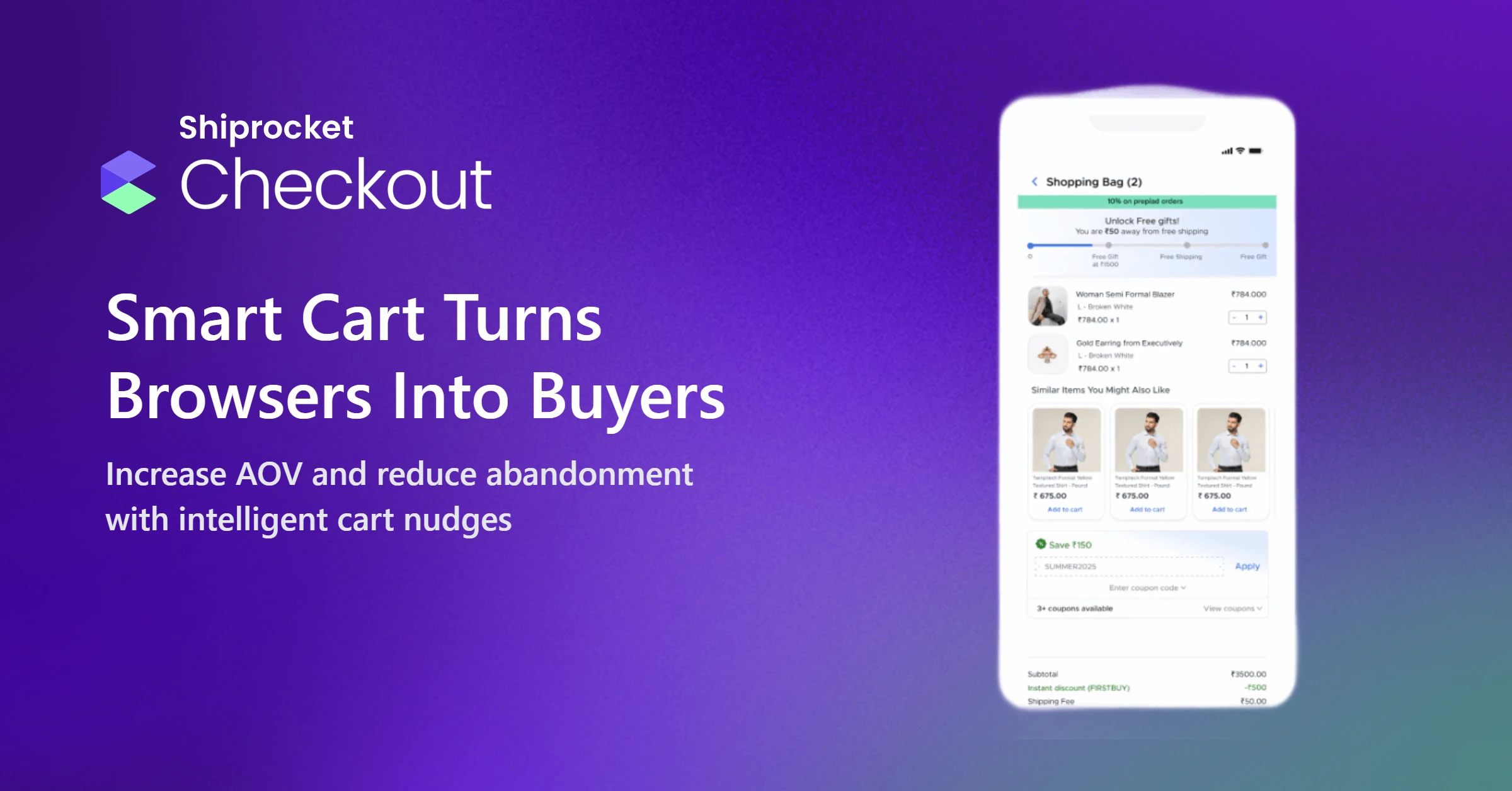
Features such as secure logins and intelligent checkout flows cause shoppers to complete their purchase faster and with greater confidence. Here is how AI-powered checkout intelligence in tools like the Shiprocket Smart Cart functions:
- Real-time behaviour analysis: Tracks pauses and hesitation points in the cart.
- Early abandonment detection: Sends timely nudges to prevent lost sales.
- Personalised promotions: Offers tailored discounts based on intent and past behaviour.
- High-value shopper identification: Helps retailers prioritise retention and offers.
- Purchase pattern analysis: Provides insights to optimise future campaigns.
Conclusion
A smart shopping cart is more than a tool; it is a way to turn potential sales into confirmed orders. By using data and AI to respond to shopper behaviour, it helps sellers reduce abandonment, increase order values, and create smoother checkout experiences.
For sellers in competitive markets, optimising the cart is no longer optional. Solutions like Shiprocket Checkout make it easier to offer fast, transparent, and personalised payment journeys, helping you win customer trust, boost conversions, and grow your business steadily.
Yes. Beyond pricing and checkout flows, you can personalise product recommendations, upsells, and promotional messages based on customer history and behaviour to increase conversion rates.
Properly implemented smart carts use asynchronous loading and caching, which can actually improve checkout speed and reduce cart drop-offs, especially on mobile devices with slower connections.
Modern carts not only encrypt data but also offer features like user consent management, data anonymisation, and regional compliance tools to meet regulations such as the DPDP Act (2023) and GDPR.
Yes. Advanced carts handle multiple currencies, region-specific taxes, shipping rules, and language localisation, helping sellers expand internationally without adding manual complexity.
Implementation depends on platform and customisation level, but most systems allow phased rollouts. Sellers can start with essential checkout improvements and gradually enable advanced features like personalised recommendations and AI-driven nudges.